
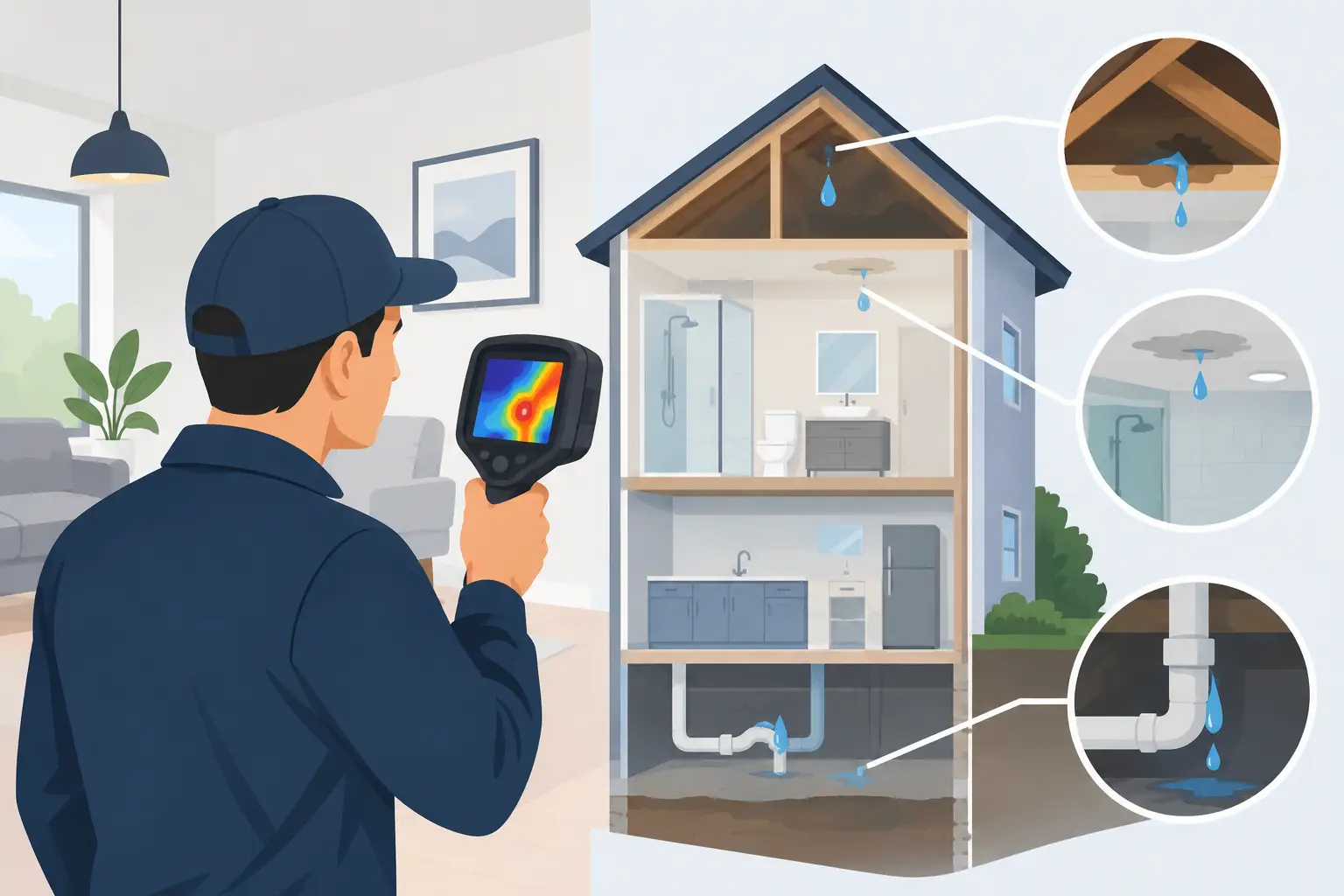
A hidden leak rarely announces itself with a burst pipe. More often, it starts with a musty smell in the basement, a brown spot spreading across a ceiling, soft flooring near a bathroom, or a water bill that suddenly climbs. Knowing how inspectors locate hidden leaks helps homeowners understand why a professional inspection can stop a small plumbing problem before it becomes major water damage or mold growth.
The First Clues Often Point to the Wrong Spot
Water travels. A stain on a first-floor ceiling may come from a second-floor bathroom, a roof issue, a leaking refrigerator line, or condensation around an HVAC component. Water can also run along framing, pipes, and floor systems before it appears where you can see it.
That is why experienced inspectors do not begin by opening walls at the first visible stain. They start by looking at the full pattern of damage. The location of peeling paint, warped baseboards, damp carpet, cracked grout, or mildew can reveal where moisture is collecting, but not always where the leak began.
A thorough inspection includes questions about when the problem started, whether it happens after rain, whether it worsens when a shower or appliance is used, and whether the home has had recent plumbing repairs. Those details help separate a supply-line leak from a drain leak, roof intrusion, foundation seepage, or condensation issue.
How Inspectors Locate Hidden Leaks Without Guesswork
Professional leak detection is a process of narrowing down the source while limiting unnecessary demolition. The exact method depends on the home, the type of plumbing, and the signs present. A leak behind a shower wall requires a different approach than water entering a finished basement after a storm.
Moisture Meters Find Water Inside Building Materials
Moisture meters are among the most useful tools in an inspection. They measure the moisture level in drywall, wood framing, subfloors, trim, and other materials. By taking readings across a wall, ceiling, or floor, an inspector can map the damp area and identify the direction the moisture is moving.
This matters because drywall can feel dry on the surface while moisture remains inside the wall cavity. A moisture meter can identify elevated readings before swelling, staining, or mold becomes obvious. It also helps determine how far water damage extends, which is essential for proper drying and repair.
Thermal Imaging Reveals Temperature Differences
An infrared camera does not see water directly. It detects changes in surface temperature. Wet building materials often cool differently than dry materials, creating a pattern that may point to concealed moisture behind walls, under flooring, or above ceilings.
Thermal imaging is especially helpful for tracing broad areas of water migration without removing materials right away. Still, a camera image alone is not proof of a leak. Cold spots can also come from missing insulation, air movement, or exterior temperature changes. A trained technician confirms suspicious areas with moisture readings and visual inspection.
Pressure Testing Helps Check Plumbing Lines
If a plumbing supply line is suspected, a plumber or qualified leak detection professional may use pressure testing. The water supply is isolated and monitored to see whether pressure drops. A drop can indicate water escaping somewhere in the system.
This approach is useful when there are no obvious signs of water at a fixture but the home has unexplained moisture or unusually high water usage. The process can help determine whether the issue is on a pressurized water line rather than a drain, appliance, or exterior source.
Drain lines are tested differently because they only leak when water is flowing through them. An inspector may run a sink, flush a toilet, fill a tub, or use controlled water testing to reproduce the conditions that cause the leak. If moisture appears only while a fixture drains, the problem is likely connected to that drain system or its surrounding seals.
Visual Inspection Still Matters
Specialized equipment is valuable, but hands-on inspection remains a big part of finding the source. Inspectors check under sinks, around toilet bases, behind washing machines, near water heaters, around dishwasher connections, and at refrigerator supply lines. They look for corrosion, loose fittings, mineral deposits, deteriorated caulk, failed grout, damaged supply hoses, and signs of past repairs.
In bathrooms, a loose shower valve, cracked shower pan, failing tub overflow, or water getting behind tile can all create hidden damage. In basements, the source may be foundation cracks, sump pump failure, drain backups, or groundwater entering through wall-floor joints. The visible water may look similar, but the repair plan is very different.
Controlled Testing Separates Plumbing Leaks From Rainwater
One of the most important questions is whether water appears during plumbing use, rainfall, or both. This is where controlled testing is helpful. A technician may test fixtures one at a time, inspect around windows and roof penetrations, or monitor an area during specific conditions.
For example, a ceiling stain below a bathroom could be caused by a leaking shower drain. But if the stain only worsens after wind-driven rain, the issue could be a roof or exterior wall leak. Treating a rainwater intrusion problem as a plumbing leak wastes time and leaves the home vulnerable to more damage.
Why Hidden Leaks Can Turn Into Mold Problems
A small leak can create a much larger problem if moisture remains in wall cavities, under flooring, or inside insulation. Mold can begin growing when damp materials are not dried promptly. It may develop behind baseboards, under laminate flooring, inside cabinetry, or in a ceiling cavity long before it becomes visible.
The goal is not simply to find the wet spot. The goal is to stop the source, remove standing water if present, dry affected materials to appropriate levels, and identify materials that cannot be safely dried or cleaned. This is where restoration work becomes critical after the plumbing repair is complete.
At Kans Water Restoration, trained technicians use moisture detection and structural drying methods to address the damage left behind by leaks, backups, and water intrusions. Finding the source is only part of getting your home back to a clean, dry condition.
Signs You Should Call for a Professional Inspection
Some warning signs deserve quick attention, especially when the source is not clear. Call for help if you notice a persistent musty odor, a ceiling stain that grows, bubbling paint, warped flooring, damp drywall, recurring mildew, or water around plumbing fixtures without an obvious reason.
You should also act quickly if you hear water running when every fixture is off, see a sudden increase in your water bill, or have a basement that repeatedly gets damp after storms. Waiting may allow water to spread into framing, insulation, flooring, and adjacent rooms.
Homeowners can take a few immediate steps while waiting for help. Move furniture and stored belongings away from wet areas, avoid using any fixture that seems connected to the leak, and do not run fans if sewage-contaminated water may be involved. If water is near outlets, appliances, or an electrical panel, keep clear of the area and use caution.
The Right Repair Depends on the Source and the Damage
Not every hidden leak requires wall removal, and not every damp surface can be saved. The right answer depends on how long the leak has been active, what materials are wet, whether the water is clean or contaminated, and how far moisture has traveled.
A newly discovered supply-line leak may need a plumbing repair and targeted drying. A slow leak behind a shower wall may require removal of damaged drywall, insulation, or tile. A drain backup or toilet overflow can require more extensive cleanup because contaminated water creates health concerns beyond ordinary moisture damage.
The best next step is fast, accurate inspection followed by a repair and drying plan that matches the actual problem. If your home has unexplained moisture, do not wait for a stain to become a collapse, a mold issue, or a major rebuild. Getting the source identified early gives you the best chance to protect the parts of your home that are still dry.

